


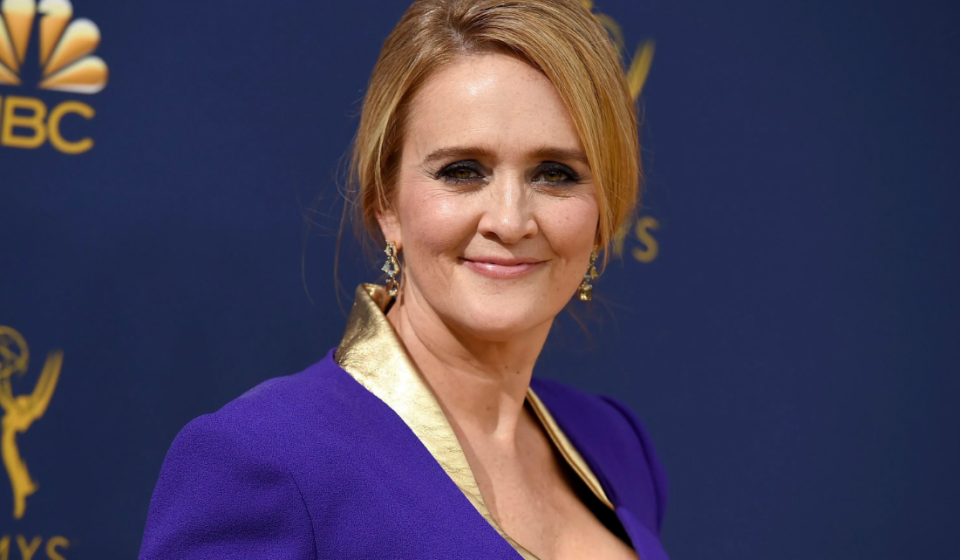

Samantha Bee has established herself as one of the most distinctive voices in contemporary political satire, blending sharp comedic instincts with a clear editorial perspective. Over the course of her career, she has navigated the intersection of entertainment, journalism, and political commentary, becoming a recognizable figure in a rapidly evolving media landscape.
Born in Toronto, Canada, Bee’s early life did not immediately point toward a career in television. She studied at McGill University and later at the University of Ottawa, initially pursuing interests outside of performance. However, her involvement in comedy began to take shape through improvisational theater, where she developed the quick-thinking and observational skills that would later define her on-screen persona.
Her major breakthrough came when she joined The Daily Show with Jon Stewart in 2003. At the time, the program was becoming an increasingly influential platform for political satire in the United States. Bee’s role as a correspondent allowed her to engage directly with real-world subjects, often conducting field interviews that combined humor with pointed critique. Her segments frequently explored social and political themes, ranging from immigration policy to cultural identity, and were noted for their confident and often confrontational tone.
During her tenure on The Daily Show, Bee became one of the longest-serving correspondents in the show’s history. This period was crucial in shaping her voice, as she learned to balance comedic timing with substantive commentary. Her work stood out not only for its humor but also for its willingness to address uncomfortable or controversial topics without softening their impact.
In 2016, Bee launched Full Frontal with Samantha Bee, marking a significant transition from correspondent to host and executive producer. The show represented a shift toward a more direct and personalized form of satire. Unlike traditional late-night programs, which often relied on monologues and celebrity interviews, Full Frontal placed a stronger emphasis on investigative segments and thematic storytelling.
The program emerged during a politically charged period, and Bee’s approach reflected the urgency of the moment. Her commentary was often more explicit and less restrained than that of her peers, positioning her as a distinctive figure within the genre. At the same time, her work continued to incorporate humor as a central element, using satire as a tool to engage audiences with complex issues.
Beyond television, Bee has been involved in writing and production, contributing to broader discussions about representation in media. As one of the few women to host a late-night satire show, her presence challenged longstanding norms within the industry. She has also participated in various public conversations about the role of comedy in political discourse, particularly in an era where traditional journalism and entertainment increasingly overlap.
Her career has not been without controversy. Certain segments and statements have generated public debate, highlighting the challenges of navigating satire in a polarized environment. However, these moments have also underscored the broader impact of her work, demonstrating how comedy can provoke discussion and reflection.
Samantha Bee’s professional trajectory reflects the changing nature of media and the growing influence of satirical commentary. By combining humor with a clear point of view, she has contributed to the ongoing evolution of political entertainment, shaping how audiences engage with current events in the digital age.

